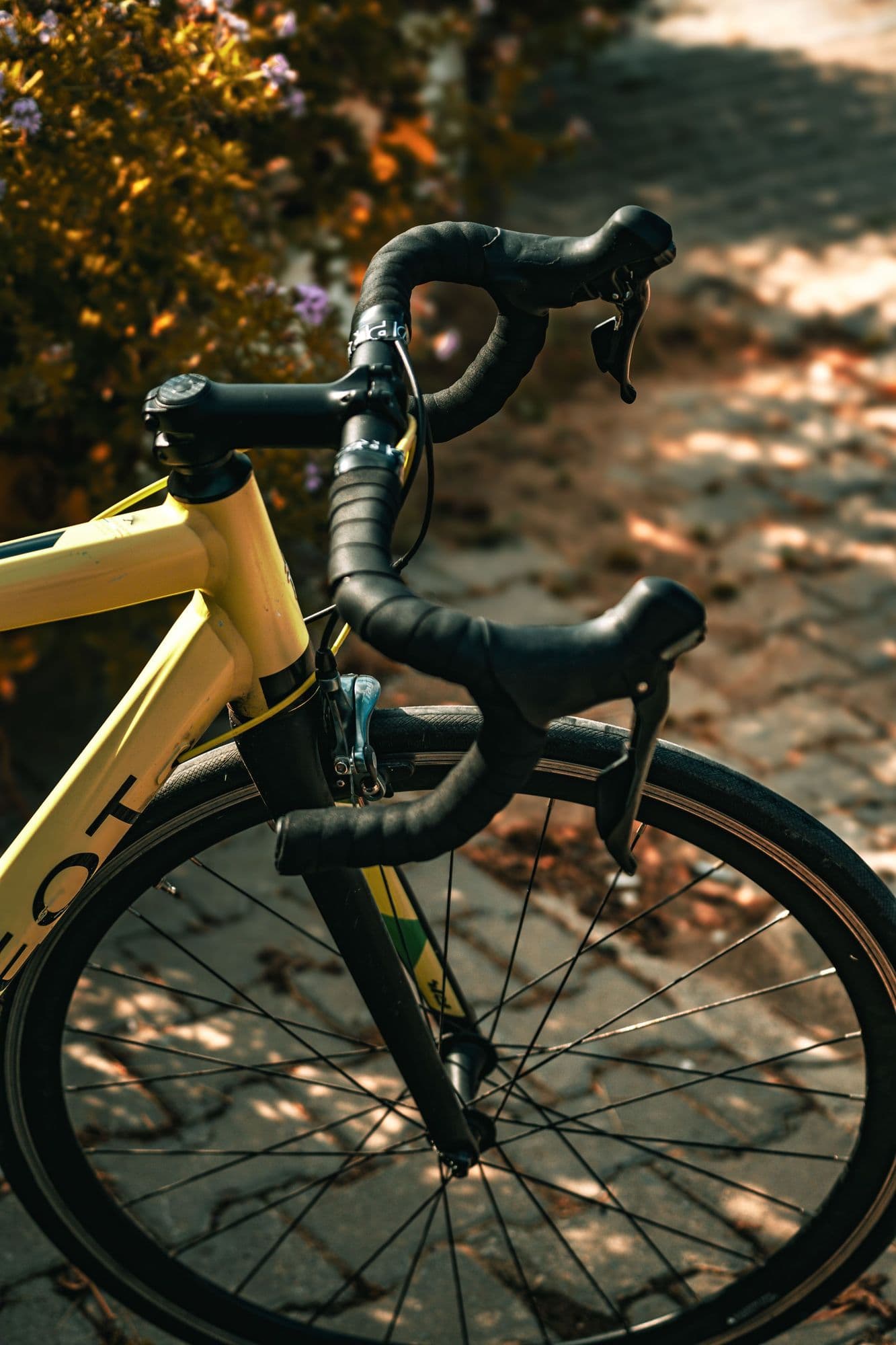
1. Three ways in, one position
You can upload a fit report, type in your numbers, or measure yourself. Fit systems measure to different points (the bottom bracket or the pedal, the saddle nose or your sit bones, the top of the bar, its clamp or the hoods), so we record how your numbers were taken and convert them to one form before any maths, following the 2024 international expert consensus on bike-fit definitions. If you connect Strava, we read your recent riding once to fine-tune the result and keep only rounded numbers.
2. Saddle height
From body measurements we set the saddle for a knee bend of about 30° with the pedal at the bottom (27.5° if you ride hard, 32.5° for comfort or knee history), using a published equation that links inseam, knee angle and seat angle. Flexible hamstrings raise it a little, tight ones lower it. We then give a sensible range (±2 % of leg length) and say plainly that changes under about 4 % of leg length make no measurable difference to efficiency or joint load. If you give us your own saddle height, it stands; we only warn if it looks far outside the knee angles the research supports.
Saddle setback can't be predicted from your body, so we give a typical starting point and the normal spread between riders rather than pretending to precision.
3. Handlebar position
How far below the saddle your bars sit is anchored on what trained riders actually use (about 13 % of saddle height, with a normal spread either side). Your chosen position moves you up or down that spread; endurance and gravel riding, age, injuries, and your riding volume if you connect Strava, adjust it further. Reach comes from your torso and arm length. We also estimate your back angle, for information. If you give us your own bar position, it stands and we tell you how it compares.
4. Cranks
We keep your crank length unless there's a reason to go 5 mm shorter: knee history, a low position, or a closed hip at the top of the stroke. Research on crank length finds no power penalty for a change of that size, while shorter cranks open the hip and knee. When we suggest it, the saddle goes up by the same amount so your leg extension is unchanged.
5. From position to frames
A frame's stack and reach describe the top of the head tube, not where your hands end up. For every frame we solve the cockpit: the stem length, stem angle and spacers that put the bars exactly where they should be, snapped to parts you can buy. Your ideal frame hits the target with a sensible, middle-of-the-range cockpit; the band around it is every frame that can still get there.
6. Handling
Your stable-to-nimble preference and the discipline set windows for head angle, trail, wheelbase, chainstays and bottom-bracket drop, scaled to your frame size. For each bike we also describe how it will feel: how light or heavy the steering is, how much of your weight sits on the front wheel, and whether your toe may touch the front tire at walking pace. Those notes describe the bike; they don't change its score.
7. Scoring
Every size gets four scores: fit (can it reach your position, and how close to the sweet spot), handling, use (category, tire clearance, wheel size, mounts) and practical (standover, saddle setback on that seat angle, crank length). We then combine this with what you told and showed us about your preferences to rank bikes.
8. How sure we are
Every line in "How we got here" carries a letter: A for international consensus or a systematic review, B for a single study, C for a population norm, D for our own estimate. Some well-known rules have no good evidence behind them, so we don't use them: knee-over-pedal-spindle, the heel-on-pedal method, inseam × 1.09, "more trail means more stable", "your height means size 54" and "an optimal crank length".
9. Known limits
- Body-measurement results are estimates and are labeled as such.
- The trained-rider norms come mostly from trained male cyclists; we'll replace them with our own data as it grows.
- Mountain-bike scoring uses static geometry; suspension sag is not modeled yet.
- The setback check assumes saddle rails about 125 mm behind the nose; short-nose saddles differ by about 20 mm.
10. Data provenance
We store factual geometry numbers with the source, capture date and method for every row. New data is checked automatically and anything unusual waits for a person; older model years are retired when a newer one arrives, and bikes whose source page disappears are retired too. Missing a bike? Request it.